
Why Imperfect Websites Drive More Sales: The Psychology of Trust
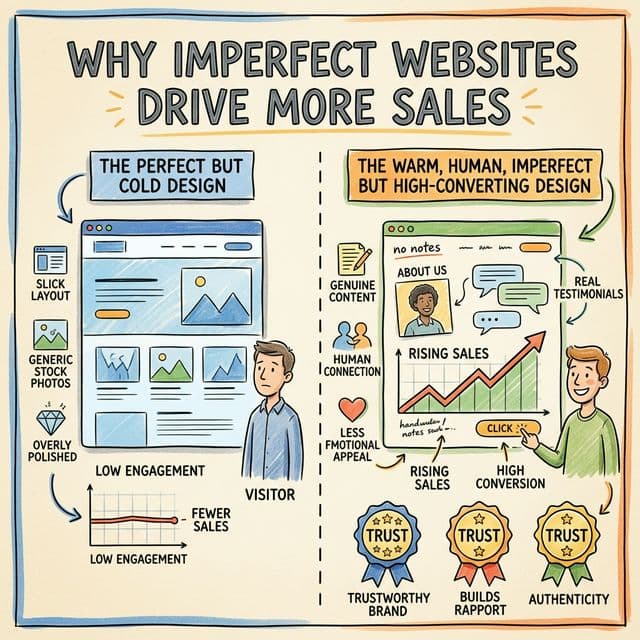
We have entered a digital era where "perfect" has become synonymous with "fake."
After nearly three decades in the web design industry, I've seen it all—from the pixelated 90s to the ultra-minimalist, high-gloss SaaS designs of today. But a strange and fascinating trend has emerged: The "slicker" a website looks, the lower its conversion rate often is.
Why? Because in an age of deepfakes, ChatGPT-written copy, and overly filtered Instagram aesthetics, our "Bulls**t Detectors" are at an all-time high.
In this article, I'll explain why an imperfect but authentic website will outperform a polished but "soulless" one every single time.
1. The "Too Good to be True" Trap
When a visitor lands on a website filled with generic stock photos of "happy people in suits" and perfectly measured, symmetrical layouts, their brain immediately categorizes it as a "Corporate Placeholder."
It feels safe, but it also feels disconnected. It doesn't scream real human beings are behind this business.
The Reality: People don't buy from corporations; they buy from people. A slightly crooked testimonial photo or a video recorded on an iPhone 15 feels "real." It lowers the visitor's guard because they can see the human hands behind the screen.
2. Authenticity Over Aesthetics
A high-converting website isn't about the perfect color palette; it's about The Message.
When you prioritize "looking pretty" over "speaking clearly," you lose the customer. Sometimes, a long-form landing page with "boring" typography but a deeply empathetic understanding of the customer's pain points will outsell a "Flashy WebGL" experience 10-to-1.
Key Authenticity Signals:
- Real Team Photos: No more stock "Help Desk" ladies. Show us your actual office, your actual pets, or your actual coffee mugs.
- Non-Stock Testimonials: A raw, unedited video of a client saying "I was skeptical, but this fixed my problem" is worth 100 perfectly polished text blurbs.
- Honest Copy: Instead of "We are the global leader in synergy," try "We help small businesses not hate their CRM."
3. The "Uncanny Valley" of Web Design
In robotics, "The Uncanny Valley" refers to the feeling of revulsion people have when an android looks almost human but not quite.
Modern web design has its own Uncanny Valley. When a site is too smooth, too fast, and too perfect, it starts to feel like a scam. We subconsciously wonder: What are they hiding behind this expensive-looking curtain?
4. Why "Ugly" Often Works Better
Check out the design of Craigslist, Wikipedia, or Berkshire Hathaway’s (Warren Buffett’s) website. They are objectively "ugly" by 2024 standards. Yet, they are some of the most trusted and functional sites on the planet.
Why? Because their design says: "We don't care about looking cool; we care about your utility."
There is a profound level of trust that comes with a site that doesn't try too hard to impress you. It assumes its value is obvious enough that it doesn't need a 3D parallax background to prove it.
5. How to be Intentionally "Imperfect"
This isn't an excuse for bad UX or broken buttons. It's about Human Design.
- Use Hand-Drawn Elements: A few "doodles" or hand-underlined text can soften a rigid layout.
- Blogger-Style Content: Write your copy as if you're explaining it over a beer, not a boardroom table.
- Show Your Process: Share "Behind the Scenes" photos or "Work in Progress" screenshots.
- Embrace the "Ugly" Mobile Photo: It outperforms the studio-lit product shot on social media and landing pages for a reason.
Conclusion: Trust is the Only Metric That Matters
Your website shouldn't be a museum of your design taste. It should be a bridge of trust between you and your customer. By embracing a bit of imperfection, you signal that you are a real person running a real business.
And in a digital world of AI-generated noise, Real is the most valuable currency you have.
Ready to stop chasing 'perfect' and start driving sales? Look at your landing page today: what’s one 'corporate' element you can replace with something human?