
The Ultimate Guide to Common Chat Abbreviations in English: Navigating Digital Lingua Franca
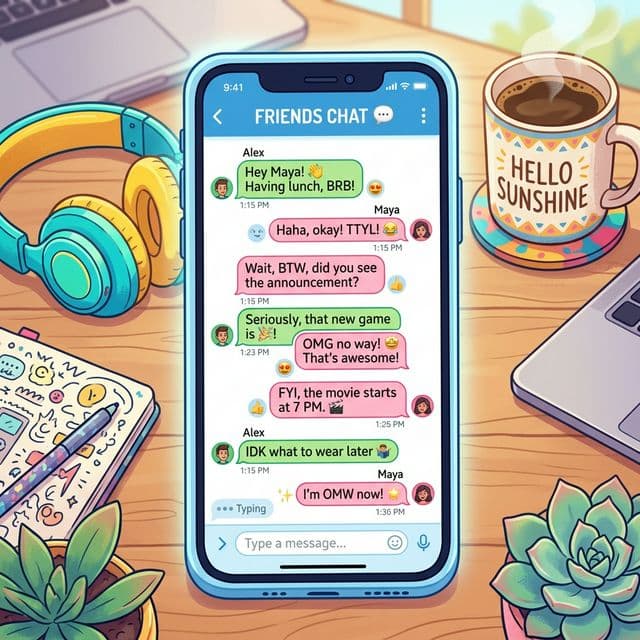
In the hyper-accelerated world of digital communication, brevity isn't just a preference—it's a survival mechanism. Whether you're navigating a fast-moving Slack channel at work or keeping up with a group chat on WhatsApp, chat abbreviations have evolved from lazy shorthand into a complex, nuanced "Digital Lingua Franca."
But using them correctly requires more than just knowing what they stand for. It requires an understanding of digital etiquette, tone, and context. In this guide, we’ll move beyond a simple list and explore the categories, origins, and professional boundaries of modern chat slang.
1. Why Do We Use Abbreviations?
The primary driver is The Principle of Least Effort. Digitally, we aim to convey the maximum amount of information with the minimum number of keystrokes. However, abbreviations also serve as social markers. Using the right shorthand signals that you are part of a specific subculture, whether that's "Tech-Twitter," "Gamer Discord," or "Corporate LinkedIn."
2. The "Essentials" (Everyday Social Slang)
These are the building blocks of modern digital English. If you’re online, you’ll see these dozens of times a day.
- LOL (Laugh Out Loud): Paradoxically, it rarely means someone is actually laughing. It's often used as a "social lubricant" to soften the tone of a sentence.
- BRB (Be Right Back): Crucial for maintaining the flow of synchronous communication (like IM or Discord).
- BTW (By The Way): Used to introduce a tangential but relevant point.
- IDK (I Don't Know): A neutral admission of ignorance.
- NGL (Not Gonna Lie): Often used before sharing a vulnerable or slightly controversial opinion.
3. Professional and Workplace Shorthand
Communication in platforms like Slack and Microsoft Teams has its own set of rules. Using "social" slang here can sometimes seem unprofessional, but "Workplace Shorthand" is highly encouraged for efficiency.
- ASAP (As Soon As Possible): The classic urgent request.
- FYI (For Your Information): Useful for sharing context without requiring a response.
- EOD / EOW (End of Day / End of Week): Critical for setting expectations and deadlines.
- OOO (Out of Office): Standard for indicating unavailability.
- WFH (Work From Home): A post-2020 staple of corporate vocabulary.
4. Emotional and Reactionary Abbreviations
Digital text lacks facial expressions and vocal tone. These abbreviations help fill that emotional gap.
- SMH (Shaking My Head): Conveys disappointment, disbelief, or mild annoyance.
- ICYMI (In Case You Missed It): A gentle way to share or reshare information.
- FOMO (Fear Of Missing Out): Now a recognized psychological term for social anxiety caused by seeing others' experiences online.
- IMO / IMHO (In My [Humble] Opinion): Essential for qualifying your statements and avoiding sounding overly assertive.
5. The "Golden Rule" of Digital Etiquette
While abbreviations are efficient, they aren't always appropriate. Here’s a quick guide on when to "Type it Out":
- High-Stakes Communication: If you’re emailing a CEO, a new client, or applying for a job, avoid abbreviations entirely.
- Clarity Over Speed: If an abbreviation is obscure (like YMMV - Your Mileage May Vary), and your audience is non-technical, you risk confusing them.
- The "Match the Room" Rule: Observe how others in a specific channel or thread are communicating. If the atmosphere is formal, stay formal.
Summary Checklist of Frequently Used Terms:
| Abbreviation | Meaning | Best Use Case |
|---|---|---|
| AFAIK | As far as I know | Qualifying information you're not 100% sure about |
| FTW | For the win | Expressing enthusiastic support for something |
| GG | Good game | Ending a competitive task or a literal game |
| LMK | Let me know | Closing a request to keep the door open for a reply |
| POV | Point of view | Setting context for a specific perspective |
| TMI | Too much information | Signaling that a topic has become too personal |
| TTYL | Talk to you later | Ending a conversation politely |
Conclusion
Mastering chat abbreviations is about more than just memorizing three-letter codes; it’s about becoming a more effective, empathetic digital communicator. By understanding the context and "vibe" of these terms, you can ensure your message is not only received but understood exactly how you intended.
What's your most used (or most hated) chat abbreviation? Let us know in the comments below!