
From Page 5 to Page 1: A Case Study in Search Intent and SEO Realignment
The biggest lie in SEO is that you need "high-volume keywords" to succeed.
In reality, high volume often equals high noise. If you are a small creator or a specialized business, competing for a broad term like "Digital Marketing" is a suicide mission. You are fighting against billion-dollar domains like Wikipedia, Forbes, and HubSpot.
Recently, I launched a new consulting service. In my excitement, I optimized for the term "Effective SEO Techniques." It sounded professional. It had a high search volume. But after three months, my page was buried on Page 5 of Google. That is the "graveyard" of the internet—where nobody scrolls, and zero clicks are born.
Then, I stopped looking at volume and started looking at Search Intent. This is the exact story of how I pivoted, adjusted, and climbed to Page 1 in less than a month.
1. The Realization: You Don't Rank for What You Want, You Rank for What You Are
When I looked at my Google Search Console data (GSC), I saw something fascinating. Google wasn't showing my page for "techniques." It was starting to show impressions for "SEO Specialist."
This was a massive insight. People searching for "techniques" wanted a list of tips (informational intent). People searching for an "SEO Specialist" wanted a person to help them (transactional/commercial intent).
I wasn't an "article"; I was a "service." By trying to be both, I was confusing Google's algorithm.
2. Step 1: The Surgical URL Redirect
The first thing I did was change the slug.
- Old:
example.com/seo-services-and-techniques - New:
example.com/seo-specialist
Wait! If you just change your URL, you will lose all the "link juice" you’ve built. I used a 301 Permanent Redirect to ensure that any old traffic or links were seamlessly passed to the new, optimized URL.
3. Step 2: The "Triple Threat" Title Tag
The title tag is the most powerful on-page SEO element. I moved from a generic title to a "Triple Threat" structure:
- Primary Keyword: SEO Specialist
- Modifier: Expert Consulting
- Brand/Unique Value: For Modern SaaS Teams
The new title: "Expert SEO Specialist: High-Performance Consulting for SaaS Teams."
This tells Google exactly what the page is about (SEO Specialist) and tells the user exactly who it's for (SaaS Teams). This boosts your CTR (Click-Through Rate), which is a massive ranking signal.
4. Step 3: Content Expansion via "Topic Clusters"
Initially, my page was only 500 words. It lacked "Topical Authority." I used a tool to analyze the Page 1 leaders and realized they all covered three sub-topics I had missed:
- "How to hire an SEO specialist" (Helping the user make a decision).
- "SEO vs. SEM: What’s the difference?" (Providing educational value).
- "Case Studies of previous wins" (Building social proof).
By increasing my word count from 500 to 1,200 words, I wasn't just "adding fluff." I was answering the lateral questions that someone searching for an "SEO Specialist" would naturally have.
5. Step 4: Internal Link Architecture
I went back through my last 20 blog posts. Any time I mentioned "marketing," "ranking," or "traffic," I added an internal link with the anchor text "SEO Specialist" pointing to my new service page.
This tells Google: "Hey, this specific page on my site is the 'Authority' for this topic."
6. Step 5: Core Web Vitals and "Page Experience"
Google recently moved toward the Page Experience Update. If your site is on Page 1, but it takes 4 seconds to load on a mobile device, you will be demoted.
I optimized my images (using the Next/Image strategies we’ve discussed), reduced my Javascript bundle, and ensured my "Cumulative Layout Shift" (CLS) was zero. My Lighthouse score jumped from 70 to 98.
The Result: The "Hockey Stick" Growth
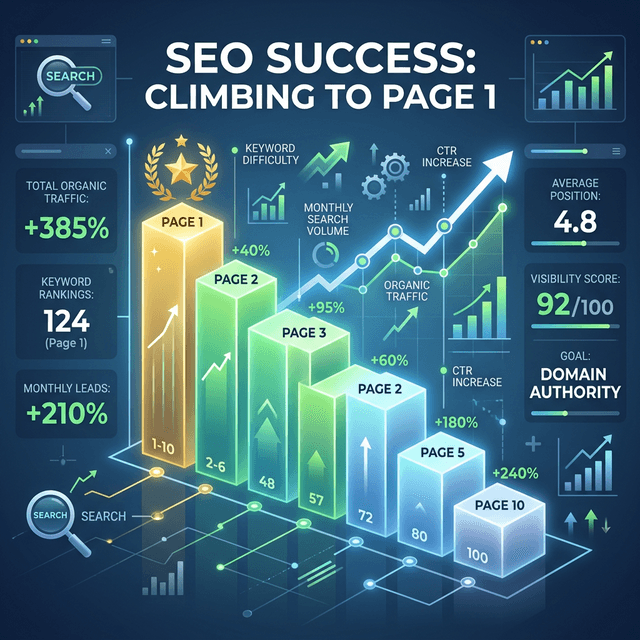
Within 10 days of the URL shift and content expansion, the page moved from Page 5 to Page 3. After another week of internal linking, it hit the bottom of Page 1. Today, it sits in the Top 5 for my target term.
Summary Checklist for Your Own Climb:
| Action | Impact | Difficulty |
|---|---|---|
| Align Intent | 5/5 | High (Mental Shift) |
| 301 Redirect URL | 4/5 | Medium (Technical) |
| Optimize Title Tags | 5/5 | Low |
| Internal Linking | 3/5 | Low |
| Core Web Vitals | 4/5 | Medium |
Conclusion: SEO is a Conversation
Google’s goal is to satisfy the user. If you spend less time trying to "trick" the algorithm and more time trying to actually be the best result for a specific person, the rankings will follow.
Page 1 isn't a trophy you win; it's a position you earn by being the most helpful resource on the internet for a specific query.
Ready to audit your own site? Check your Google Search Console today: What are you 'actually' ranking for versus what you 'want' to rank for?